PKC and dFoxP are necessary for operant self-learning
- Version [version]
- Download 2956
- File Size 3.13 MB
- File Count 1
- Create Date April 17, 2015
- Last Updated April 17, 2015
PKC and dFoxP are necessary for operant self-learning
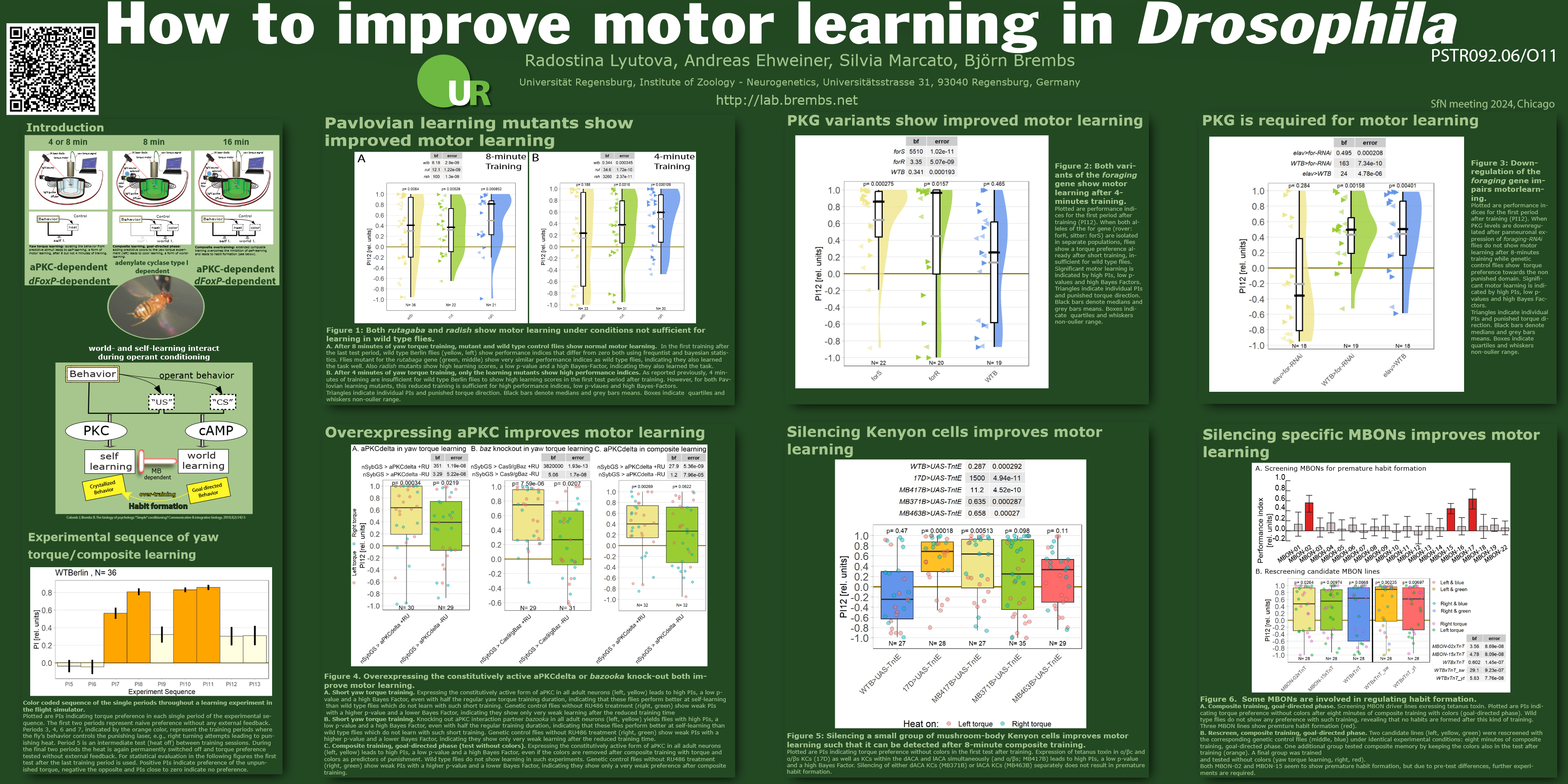
World-learning (the process assigning value to sensory stimuli) and self-learning (the process assigning value to a specific action or movement) are two biological components of operant learning. The fundamental value of the distinction between self- and world-learning is reflected in similar dichotomies developed from disparate paradigms such as declarative vs procedural memories, allocentric vs egocentric navigation strategies, or learning external cues vs self-motion cues. Our results suggest that motor skill learning, habit formation and birdsong crystallization are all different instantiations of a self-learning process. Unlike most paradigms, in stationarily flying Drosophila fruit flies at the torque meter apparatus (“flight simulator”), world- and self-learning can be separated and studied independently. Work in fly, Aplysia and mouse suggested that PKC inhibition impairs self-learning.
We used genetic tools (UAS/Gal4 TARGET ) to spatially and temporally restrict the inhibition of PKC in the fly nervous system. The data suggest that acute PKC inhibition in motorneurons is sufficient to prevent self-learning. In order to identify the PKC isoform relevant for self-learning, we have been restricting a RNAi-based knockdown of different PKC isoforms to adult flies, thereby avoiding potential compensatory mechanisms during development.
Experiments in other animals suggested to test the function of the Drosophila FoxP gene in self-learning: the vertebrate FoxP1 and FoxP2 genes have been reported to be involved in both language acquisition in humans and song learning in songbirds (both processes can be conceptualized as instances of operant self-learning). Mutant analysis and RNAi-mediated knockdown of one isoform of dFoxP reveal a specific role of dFoxP in self-learning but not in other forms of learning. These data suggest a deep homology for the acquisition of skilled movements originating before the split between vertebrates and invertebrates. This process critically involves PKC and FoxP genes, but not components of the canonical synaptic plasticity pathways.