

|
|
There's a new paper out by the group of Nicky Clayton, Cambridge, in the April 4 issue of Current Biology. I know Nicky from the Social Science Research Council sponsored workshop "Behavioral Organization in Animals" in Bodega Bay (see program). In their study, the researchers used the popular ‘trap-tube’ task to assay the extent of physical cognition (specifically, an understanding of the operation of gravity) in rooks. In the experiment, food is placed inside a horizontal tube which has a vertical, blind-ended tube attached to it. The animals had to push (or pull) the item from the appropriate end of the tube using a stick, so that they do not lose the item in the trap. Seven out of eight rooks learned the task and all seven passed a transfer test, in which the food had to be dropped into the trap to be accessible (see picture).
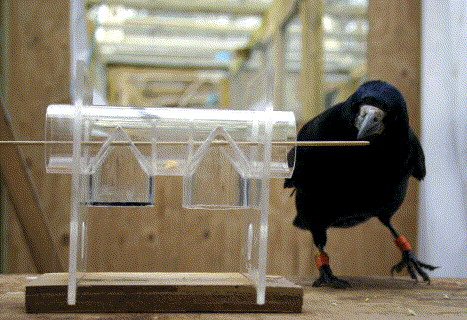
The authors hypothesize that the rooks have a sense of gravity ("physical cognition") and may use learning to abstract rules to acquire it. There was a fairly recent (2002) report in the journal Science by Weir, Chappell and Kacelnik, who showed that New Caledonian crows are able to shape unfamiliar materials to create a usable tool for a specific task. These corvids don't have birdbrains, it seems
|
 |
|
|
Comments
Matt
Guest
|
10 May : 20:16
|
Hi, I read that article too. I guess I just dont get the big difference. The 'recursive' sequences were of the form AB, AABB, AAABBB, etc. But I fail to see why those sequences require a radically different form of recognition. On the other hand, the fact that the tamarins couldn't learn these sequences is interesting. I would be interested in your comments. Thanks, Matt
|
bjoern

Comments: 63
Location: Berlin, Germany
|
11 May : 03:49
|
For us, it doesn't seem to be such a big deal to differentiate AABB from ABAB. I guess this is because it's so engrained in our language. But for animals, it's not that easy. I guess that's because both sequences contain the same number of As and Bs and so are very similar in "content". My prediction would be that quite a few species will be able to discriminate ABAB from AABB, but you would need to train them operantly, i.e. they need to really have to work for the food and be engaged. Moreover, you might need to use very specific stimuli that match the sort of stimuli the animals are faced with in their "normal" life (as the song sounds for the starlings). It may be that the researchers studying the tamarins also thought "ha, this should be no big deal for them, let's see if they can do it!". More studies clearly need to be performed on more species to find out if the distinction really is difficult, or maybe we're just not asking the animals in the right way. Does that address your line of thought?
|
bjoern

Comments: 63
Location: Berlin, Germany
|
11 May : 03:49
|
BTW, shouldn't these comments have goe to the starling entry? Did you accidentally post yours in this entry, or is there a bug in the comments function?
|
All trademarks are © their respective owners, all other content is © bjoern.brembs.net. e107 is © e107.org and is released under the GNU GPL license.
|
Welcome Guest
Currently Online Members: (0) Guests: (22) | | | | | | |
 |
194.186.xx.xx is in index |
| | | | | | | | | | | | | | |
Extra Information Latest changes | Click here to see whats new Since last time, there's been 382 new news items  38 new content posts  180 new comments  232 new chatbox posts  68 new downloads  864 new pictures  18 new links  63 new site members  |
Hit Counter
This page today... total: 3 unique: 1
This page ever... total: 1803 unique: 983
This Site ... total: 85874 unique: 46637 Most online at once: 169 (Members: 0, Guests: 169) on Tue Oct 23 2007, 03:12PM
Random pics
  click to open in new window
RSS Feeds
Our news can be syndicated by using these rss feeds.
|