Is PKC53e-activity in motorneurons involved in operant self-learning in Drosophila?
- Version [version]
- Download 2685
- File Size 2.89 MB
- File Count 1
- Create Date April 17, 2015
- Last Updated April 17, 2015
Is PKC53e-activity in motorneurons involved in operant self-learning in Drosophila?
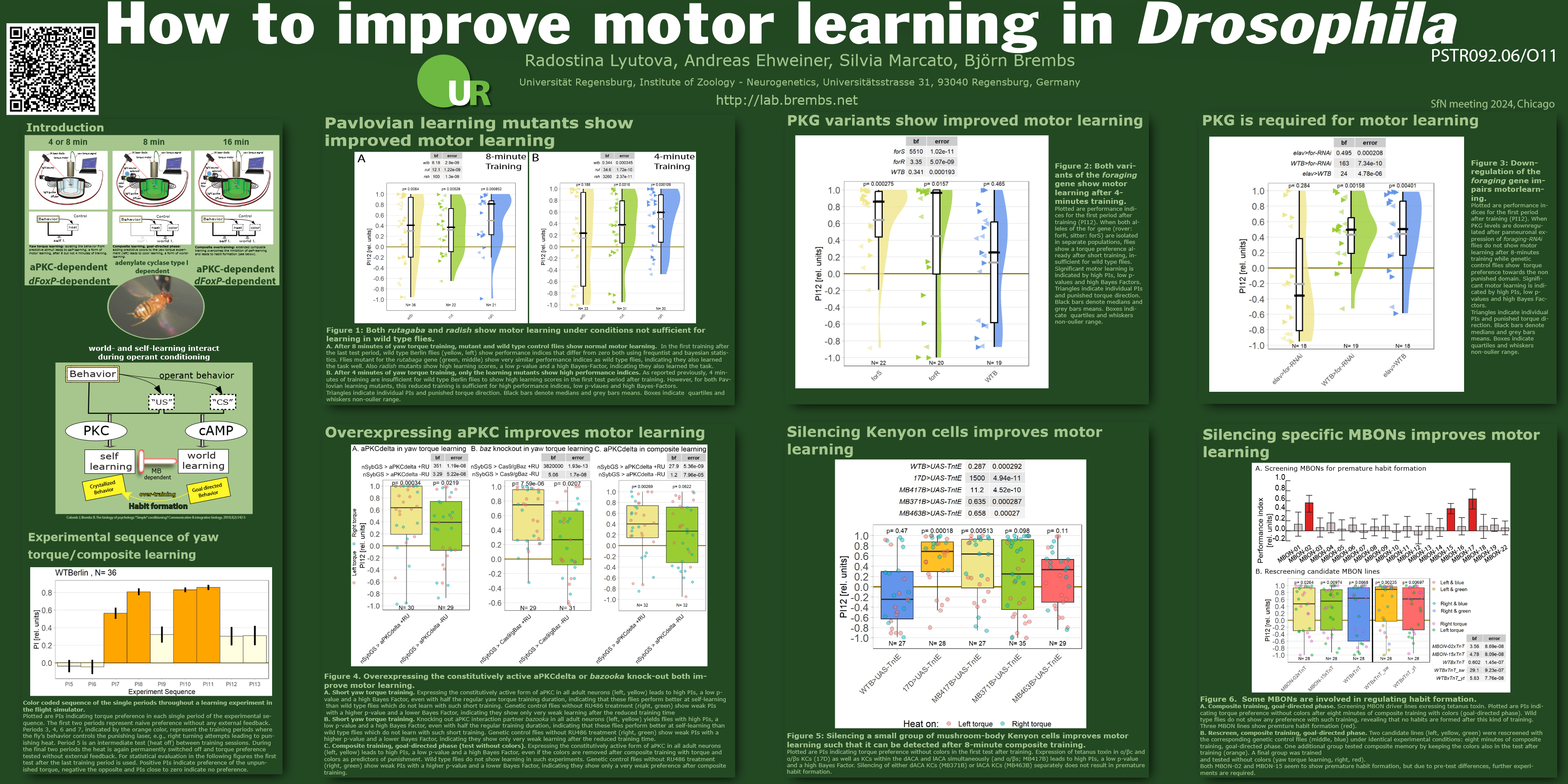
During operant (instrumental) learning, subjects may learn to associate external cues (world-learning) and/or their self-generated motor program (self-learning) with reward or punishment. In previous work we were able to dissociate these two forms of learning in different paradigms using the fly torque meter apparatus (flight simulator), and showed that each form of learning depends on a different molecular pathway (1). The gene coding for the Drosophila type I adenylyl cyclase 'rutabaga' is necessary for operant world-learning, while an inhibition of Protein Kinase C (PKC) prevents operant self-learning. Analogous results have also been obtained in the marine snail Aplysia (2) and two vertebrate species (3,4).
Here, we analyzed which one of the six Drosophila PKC genes is involved in which neurons in operant self-learning. Different experiments with the 'Target' system in Drosophila - which allows both temporal and spacial control of the expression of either a PKC inhibitory peptide (PKCi) or of RNAi constructs against the different PKC genes - suggest an essential role of PKC 53e in motorneurons during self-learning in Drosophila.
- Brembs, B. and Plendl, W. (2008): Double dissociation of protein-kinase C and adenylyl cyclase manipulations on operant and classical learning in Drosophila. Curr. Biol. 18(15):1168-1171.
- Lorenzetti FD, Baxter DA, Byrne JH (2008): Molecular mechanisms underlying a cellular analog of operant reward learning. 59(5):815-828
- Rochefort C, Arabo A, André M, Poucet B, Save E, Rondi-Reig L. (2011): Cerebellum shapes hippocampal spatial code. Science 334(6054):385-389.
- Sakaguchi H, Yamaguchi A. (1997): Early song-deprivation affects the expression of protein kinase C in the song control nuclei of the zebra finch during a sensitive period of song learning. Neuroreport. 8(12):2645-50.