The biology of psychology: ‘Simple’ conditioning?
- Version [version]
- Download 2601
- File Size 983.48 KB
- File Count 1
- Create Date January 5, 2015
- Last Updated April 17, 2015
The biology of psychology: 'Simple' conditioning?
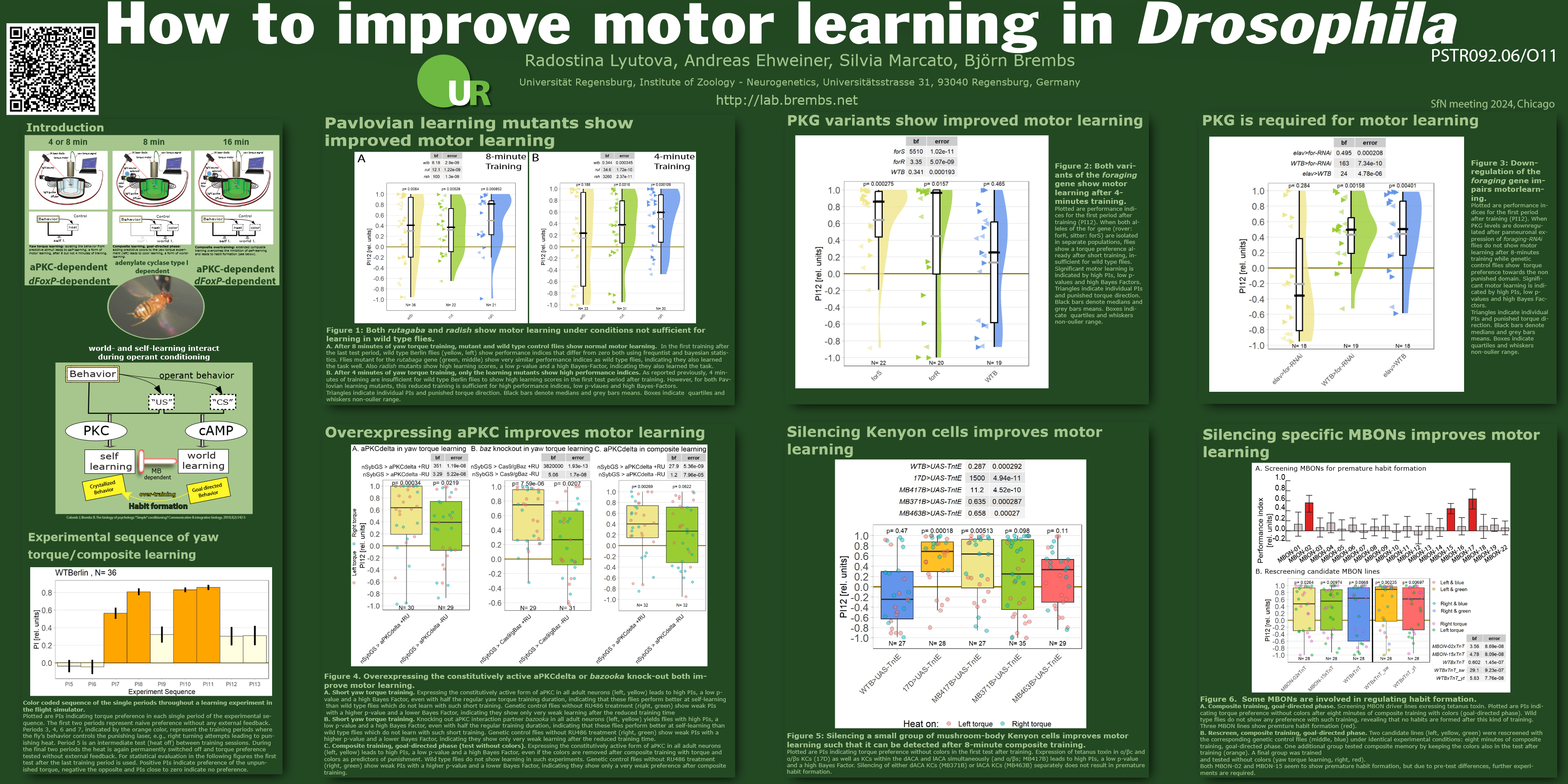
Operant (instrumental) and classical (Pavlovian) conditioning are taught as the simplest forms of associative learning. Recent research in several invertebrate model systems has now accumulated evidence that the dichotomy is not as simple as it seemed. During operant learning in the fruit fly Drosophila, at least two genetically distinct learning systems interact dynamically. Inspired by analogous results in three other research fields, we propose to term one of these systems world-learning (assigning value to sensory stimuli) and the other self-learning (assigning value to a specific action or movement). During the goal-directed phase of operant learning, world-learning inhibits self-learning (in Drosophila via the mushroom-body neuropil), to allow for flexible generalization. Extended training overcomes this inhibition in a phase transition akin to habit formation in vertebrates, allowing self-learning to transform spontaneous actions to habitual responses. In part, these insights were achieved by reducing operant experiments beyond the traditional set-ups (i.e., 'pure' operant learning) and using modern, molecular and/or genetic model systems.