The Drosophila FoxP gene is required for operant self-learning: Implications for the evolution of language acquisition
- Version [version]
- Download 2607
- File Size 1.17 MB
- File Count 1
- Create Date April 17, 2015
- Last Updated April 17, 2015
The Drosophila FoxP gene is required for operant self-learning: Implications for the evolution of language acquisition
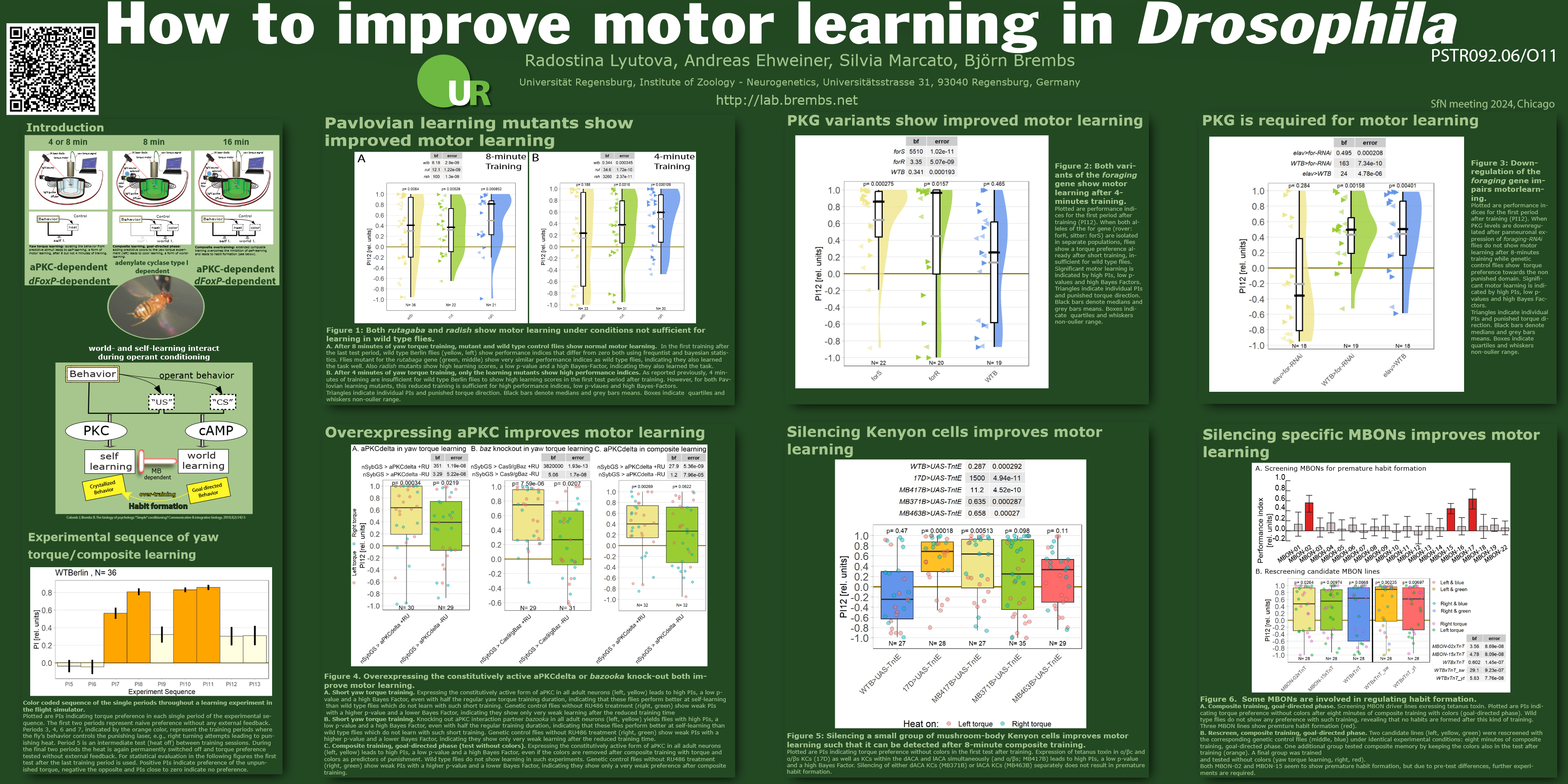
In humans, mutations of the transcription factor Forkhead box protein P2 (FoxP2) cause a severe speech and language disorder. Downregulating the Zebrafinch FoxP2 orthologue in development results in incomplete and inaccurate song imitation. These forms of vocal learning exhibit two common characteristics: 1. Spontaneous initiation of behavior (‘trying out’); 2. Evaluation of sensory feedback shaping behavior. Using a torque learning essay in which both characteristics have been realized, we investigated the involvement of the fly orthologue, dFoxP, in operant self-learning in the fruit fly Drosophila. The experiments were performed using stationary flying Drosophila at the torque compensator with heat as punishment. Both a P-Element insertion and RNAi-mediated knockdown of the isoform B of the Drosophila FoxP gene did not lead to an impairment in operant world-learning, i.e., color-learning, compared to control flies. However, both fly strains were impaired in operant self-learning, i.e., yaw-torque learning without any environmental predictors. Only this form of learning, operant self-learning, is conceptually similar to language acquisition. Neither the FoxP intron retention isoform nor isoform A appear to be involved in this form of learning. These results suggest a specific involvement of isoform B of the Drosophila FoxP gene in the neural plasticity underlying operant self-learning but not in other forms of learning. Further underscoring the conceptual parallels of operant self-learning with language acquisition, habit formation in flies is also affected by mutations
in the dFoxP gene.
Perhaps not surprisingly, these results are consistent with the hypothesis that one of the evolutionary roots of language is the ability to directly modify the neural circuits controlling behavior. It is noteworthy that these roots can apparently be traced back to the Ur-bilaterian, the last common ancestor of vertebrates and invertebrates.