bjoern.brembs.blog

The blog of neurobiologist Björn Brembs

Search

Main Menu

  • Home
  • About
  • Publications
  • Citations
  • Downloads
  • Resume
  • Interests
  • Contact
  • Archive

Tag Cloud

behavior brain career chance classical competition conditioning data decision-making Drosophila Elsevier evolution FoxP free will fun funders GlamMagz habit formation impact factor infrastructure journal rank journals learning libraries mandates neurogenetics neuroscience open access open data open science operant peer-review politics poster publishers publishing retractions SciELO science self-learning SfN spontaneity subscriptions variability video

Categories

  • blogarchives
  • I get email
  • news
  • own data
  • personal
  • random science video
  • researchblogging
  • science
  • science news
  • science politics
  • server
  • Tweetlog
  • Uncategorized

Recent Downloads

Icon
Searching for the molecular mediators of motor learning in Drosophila 47 downloads 0.00 KB
Download
Icon
How do the mushroom bodies regulate habit formation in Drosophila? 77 downloads 0.00 KB
Download
Icon
Flexible Valence Coding by Dopaminergic Neurons in Drosophila 70 downloads 0.00 KB
Download
Icon
Motor learning in fruit flies: what happens where and how to improve it 555 downloads 0.00 KB
Download
Icon
Investigating innate valence signals in Drosophila: Probing dopaminergic function of PPM2 neurons with optogenetics 174 downloads 0.00 KB
Download
May20

Why haven’t we already canceled all subscriptions?

In: science politics • Tags: infrastructure, money, subscriptions

The question in the title is serious: of the ~US$10 billion we collectively pay publishers annually world-wide to hide publicly funded research behind paywalls, we already know that only between 200-800 million go towards actual costs. The rest goes towards profits (~3-4 billion) and paywalls/other inefficiencies (~5 billion). What do we get for overpaying such services by about 98%? We get a literature that essentially lacks every basic functionality we’ve come to expect from any digital object:

  • Limited access
  • Link-rot
  • No scientific impact analysis
  • Lousy peer-review
  • No global search
  • No functional hyperlinks
  • Useless data visualization
  • No submission standards
  • (Almost) no statistics
  • No content-mining
  • No effective way to sort, filter and discover
  • No semantic enrichment
  • No networking feature
  • etc.

Moreover, inasmuch as we use the literature (i.e., in terms of productivity and/or journal rank) to help us select the scientists for promotion and funding, we select the candidates publishing the least reliable science.

Taken together, we pay 10 billion for something we could have for 200 million in order to buy us a completely antiquated, dysfunctional literature that tricks us into selecting the wrong people. If that isn’t enough to hit the emergency brakes, what is?

We may not be able to buy paradise with 10b annually, but with such a low bar, it’s easy to get anything that’s at least not equally abysmal. The kind of modern technology we can buy would probably solve most of the most pressing issues with our literature, cover all our needs in terms of data and make sure we can cite and reuse all scientific code in a version-controlled manner – and then leave a few billion to play around with every year.

With the fruits of our labor firmly in our own control, we would have a flourishing market of services, such that whenever our digital infrastructure would lack the functionalities we expect or becomes too expensive, we can either switch service providers or hire our own experts without loosing our content.

As an added benefit, cutting the steady stream of obscene amounts of money to a parasitic industry with orthogonal interests to scholarship would prevent further buyouts of scholarly ventures such as Mendeley or SSRN and with it the disappearance of valuable scholarly data in the dark underbelly of international corporations.

One reason often brought up against canceling subscriptions is that faculty would complain about the lack of access subscription cancellations would entail. However, already published literature can in principle (although substantial technical hurdles still need to be overcome) be accessed via a clever combination of services such as automated, single-click inter-library loan, LOCKSS and Portico. Moreover, some libraries have seen substantial cost-savings by canceling subscriptions and instead supporting individual article downloads. Finally, institutional repositories as well as pre-print archives need to be leveraged whenever the publisher-version isn’t available. After all, we have DOAI and the pre-print versions are almost identical to the final article. With such an effort, most users likely wouldn’t experience more than maybe a few hiccups, but they’re already used to patchy access anyway, so it wouldn’t look vastly different from what people are experiencing now. In fact, if subscriptions were canceled, there would be a substantial incentive to get the most modern access tools and to keep them up to date, so for many institutions this might actually increase the spread and ease of access, compared to the current largely subscription-only access model. Thus, it is technically feasible to cancel all subscriptions in a way that most users probably wouldn’t even notice it. Essentially, all we’d have to manage is replacing one patchy access system with another patchy access system. While this may not exist out-of-the-box, yet, it should not be too complicated to assemble from existing technologies. One could call this a “legal Sci-Hub“. Add to that an information campaign that alerts users that while no major disruption is anticipated during the transition, some minor problems may arise, and everyone will support this two decades overdue modernization.

Another reason often provided is that the international cooperation between institutions required for such a system-wide cancellation to be effective were impossible to accomplish. That is a problem less easily dismissed than the supposed lack of access to the literature. After all, some governments explicitly don’t want their institutions to cooperate, they want them to compete, and even to develop “world-class competitiveness” (page 17):

competitiveness

In this regard, I recently listened to a podcast interview with Benjamin Peters, author of “How not to network a nation“. His description of the failure to develop the internet in the Soviet Union (compared to the successful developments in the West) reads like an account of how not to make open access a reality:

the American ARPANET took shape thanks to well-managed state subsidies and collaborative research environments and the Soviet network projects stumbled because of unregulated competition among self-interested institutions, bureaucrats, and others.

We need the same collaborative spirit if institutions are to abandon subscriptions, just as they cooperated to spend money to draw cables between institutions, even though they were separated by borders and even oceans. If in the 1980s, our institutions collaborated across nations and continents to spend money on a research infrastructure nobody yet knew, can’t they collaborate now to save money being wasted on an obviously outdated infrastructure? Has neoliberal worship of competition poisoned our academic institutions to such a degree, that within 25 years they went from cooperating even if it means spending money to never cooperating even if it means saving money? I refuse to believe that, even though that’s what some try to tell me.

Instead of trying to tell scholars to behave ethically in spite of the downsides to them personally, maybe we ought to tell institutions that our infrastructure is outdated and that we need the functionalities everybody else but academics are enjoying? We need to get the same mechanisms going that in the 1980s got our universities to invest in networking hardware and cables, despite a functioning telephone and snail mail system. Cancelling subscriptions doesn’t mean losing access, so nobody can tell me that canceling subscriptions is more difficult than installing compatible networking hardware across the globe. I’m now paying for my phone bills out of my budget, while my skype calls are provided by my university. Maybe rather than trying to convince scholars to choose the ethical over the advantageous, it would be more effective to ask our institutions to provide us with modern technology and have those who still want to use the legacy version pay for it themselves?

Framing our issue as an ethical one (“the public needs access to publicly funded research!”) may work, but it is a slow, ineffective and uncertain approach. Framing it as merely a technical modernization strikes me as potentially quicker, straightforward and effective.

UPDATE (May 23, 2016):

Some people have asked for evidence that canceling subscriptions and instead relying on individual downloads can save money. Besides hearsay from several libraries, this is a piece of evidence which should be quite convincing that this can work for some publisher/library combinations (click for larger version):
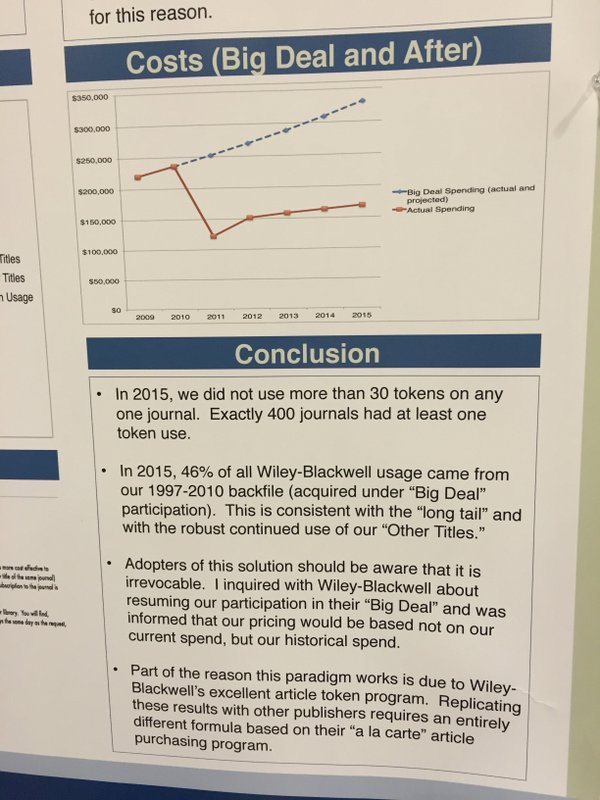
wiley tokensSo if libraries were to cooperate in identifying more such opportunities and then cleverly combine this action with LOCKSS and/or Portico as well as smart (single-click) ILL between those libraries whose Big Deals have already run out and those which are still running, given enough participants, almost all of the already published literature ought to be accessible. It may not be trivial, but it’s definitely feasible and the technical problems are not the main obstacle – it’s the collaboration that needs to be established. Moreover, this only needs to work for a relatively short time, until most of the journals have run dry of funding and ceased to exist.

Update to the update (June 8, 2016): Similar to the example above, other libraries have canceled big deals and come out ahead. Also here, providing previously subscribed content combined with rapid ILL from collaborating institutions worked just fine. (Link thanks to Micah, in the comments)

Indeed, the OA Tracking project at Harvard is collecting such examples under their own oa.cancellations tag. Quite a nice list of cancellations there. It’s a fact, canceling subscriptions can be done without faculty revolt and with substantial savings.

UPDATE II

Triggered by online discussions, a few hypothetical use cases:

  1. A user is requesting an older document from a journal that their institution longer subscribes to, but was accessible in the past. The link resolver checks if it can be served via LOCKSS or Portico. If not (weird that LOCKSS/Portico would not serve if content was already purchased before!?), then the resolver extracts the article meta-data (importantly, the DOI for use with DOAI) and screens the institutional repositories or places such as PubMedCentral, arXiv/bioarxiv or ResearchGate for the document. If all that fails, the link resolver checks for ILL availability with an institution whose Big Deal has not expired, yet. If none of these 3/4 services can serve the document, then ask user if they want to send copy request to author (single click) or download individual article and pay the fee (faculty get informed about their usage/costs!).
  2. A user is requesting a brand new article from a journal that their institution is not subscribing to. The link resolver extracts the article meta-data (importantly, the DOI for use with DOAI) and checks for availability in repositories. If unavailable, check for ILL. Both not available, ask user if they want to send copy request to author (single click) or download individual article and pay the fee (faculty get informed about their usage/costs!).
  3. A user is requesting an older document from a journal their institution never subscribed to. The link resolver extracts the article meta-data (importantly, the DOI for use with DOAI) and checks all relevant repositories, then ILL. If both fail ask user if they want to send copy request to author (single click) or download individual article and pay the fee (faculty get informed about their usage/costs!).

UPDATE III (Jan 17, 2017):

I’ve collected a short list of ten different ways to access journal articles without a subscription, nine of them completely legal. Clearly, canceling subscriptions (or not renewing them) is not the big deal it once was. If we used the saved funds to invest it in our digital infrastructure, by the time all subscriptions had run out, we would look back and wonder what took us so long.

UPDATE IV (Feb 16, 2017):

Since the start of 2017, about 60 German institutions lost all access to the journals of publisher giant Elsevier. According to a news report:

The loss of access to Elsevier content didn’t overly disturb academic routines, researchers say, because they found other ways to get papers they needed

It’s official. It works. We don’t need subscriptions.

UPDATE V (May 2, 2017):

In addition to the long list of reports about successful and painless subscription cancellations, there is now an evaluation of an informal survey of 31 US-based libraries. 24 of the sample had cancelled Big Deal subscriptions and the author’s conclusion was that “relatively few libraries that actually do cancel their Big Deals end up regretting it”. Obviously, more and more libraries realize that subscriptions are bad value for money and do just fine without them.

UPDATE VI (December 14, 2017):

SPARC is now also tracking big deal cancellations across the globe. It can be done, the evidence is out there for all to see.
Posted on May 20, 2016 at 17:32 59 Comments
May12

On the productivity of scientists

In: science politics • Tags: competition, neoliberalism, productivity

“an academic career, in which a person is forced to produce scientific writings in great amounts, creates a danger of intellectual superficiality”

Albert Einstein

Isaacson W (2008) Einstein (His Life and Universe) (Simon and Schuster, New York), 1st Ed, p 79


Ever since Reagan and Thatcher made neoliberal ideas palatable to an unsuspecting public, concepts such as “New Public Management” or the more general notion that competition between institutions and individuals are key to eliminating the (probably nonexistent or at least negligible) problem of “dead wood”, have slowly crept into academia as well.

The consequences on the institutional level are quite well documented: The increase of the precariat of (adjunct) faculty without benefits or tenure, a growing layer of administration and bureaucracy, or the increase in student debt. In part, this well-known corporate strategy serves to increase labor servility. The student debt problem is particularly obvious in countries with tuition fees, especially in the US where a convincing argument has been made that the tuition system is nearing its breaking point. The decrease in tenured positions is also quite well documented (see e.g., an old post).

On the individual level, tenure, promotion and funding in many places now depend on the number of publications (in certain journals; i.e., “publish or perish”) or one’s creativity in designing the most expensive way to do their research (i.e., amount of grant income). While the incentives to waste tax-funds are rather obvious, it is probably more difficult to immediately see anything wrong with rewarding productivity. After all, researchers live off the public teat, shouldn’t they provide something tangible in return?

The issue lies, of course, in how to measure productivity. In many areas, not only science, Einstein’s dictum holds: “not everything that can be counted counts and not everything that counts can be counted”. There are at least two main issues with exerting selection pressure on scientists by using a count of research papers.

  1. It is likely only of specific value to some positions/institutions to hire/promote/fund researchers who excel at milking the most publications out of a given research question. In other words, while we should not exclude this kind of research, it is probably not to a general benefit if we primarily select those scientists who are especially gifted for identifying the fields of inquiry where a research paper is always just a fortnight away. Applied across the board, this strategy leaves the more challenging research questions without adequate staffing.
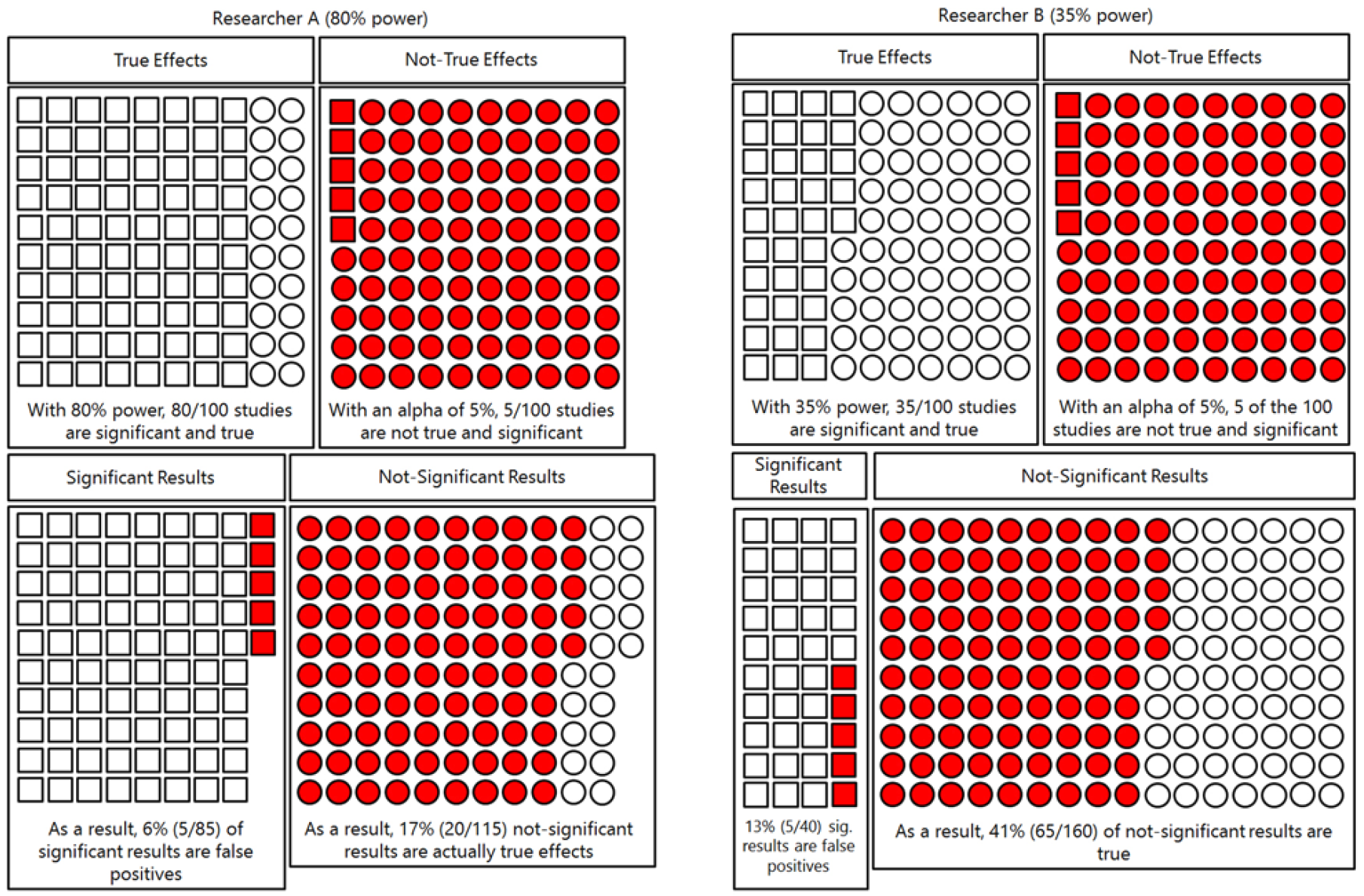
  2. In the experimental sciences, there is a statistical risk that the most productive researcher is also the one producing the least reliable publications. The point was made in great detail by Daniel Lakens in his paper “Sailing From the Seas of Chaos Into the Corridor of Stability: Practical Recommendations to Increase the Informational Value of Studies”. In brief, the argument is that a research strategy that aims at many low-powered studies (rather than fewer adequately powered ones) yields more statistically significant (and hence publishable) results. The figure (Fig. 1 in Daniel’s paper) below exemplifies this very nicely, I think:
power

Ratio of false-to-true positives and false-to-true negatives for the two researchers performing studies at 80% or 35% power. Both Researcher 1 and Researcher 2 conduct 200 experiments in which they examine 100 true ideas (in white) and 100 false ideas (in gray). Squares represent significant results, and circles represent nonsignificant results

In the above example, if one were to assume that researcher B would be able to do, say, 100 studies, researcher A would be able to accomplish 44 studies in the same time, all else being equal. In this hypothetical scenario, Researcher B would end up with 21 significant results, while Researcher A would only obtain 19.

We obviously don’t really know many of the parameters required to accurately estimate how successful any such strategies would be in our current research settings. [UPDATE: A modeling study (adequately titled “the natural selection of bad science“) recently confirmed that the above scenario is indeed quite realistic.] However, the fact that one can conceive of plausible situations where productivity is an indicator of sloppiness ought to ring alarm bells, especially in times when the reliability of science is becoming a major concern.

Hence, for these two reasons alone, be wary of the competence of anyone who uses ‘productivity’ as a criterion to evaluate researchers.

Together with the fact that we also reward scientists who publish in journals with a track record of unreliability, we should not discard concerns off-hand that we ourselves have contributed to the current situation by falling prey to the neoliberal idea that measurable performance is the prime criterion by which we can justify our selection of faculty. If the available data are correct indicating that we may have been selecting those researchers who publish the least reliable science for several decades now, we ought not to be surprised if we find that the reliability of science has been slipping.

P.S.: A similar argument has been made today in an editorial (easier to read with less data and statistics). See also this relevant post from 2013.

P.P.S.: On Facebook, Aaron Blaisdell from UCLA commented that counting papers is “a great way to measure whether a scientist puts ambition ahead of curiosity, scientific rigor and the quest for knowledge and understanding.” In this discussion, Bill Hooker was quick to point out that it may also measure how caught up in the system early career researchers have become.

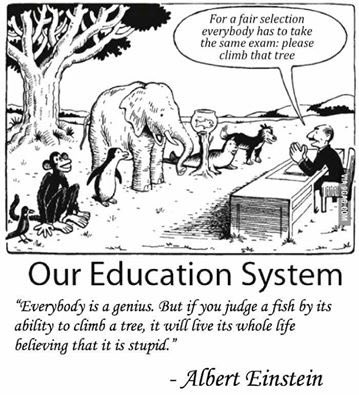
Of course, the basic idea behind this argument isn’t all that new:

measure performance

Posted on May 12, 2016 at 11:01 68 Comments
May04

Academic publishers and competition

In: science politics • Tags: competition, publishers

Scholarly journals, on the face of it, emerged in the 17th century as a medium to facilitate communication of scientific discoveries among interested scholars. In the 21st century, it’s not all that different: researchers form communities around topics in which they share a common interest: Journal of Neuroscience, Pediatrics and Neonatology, Journal of Economics or the British Educational Research Journal. There are currently over 30,000 such journals, all serving a group of scholars with an interest in the topic of the journal.

In order to run a scholarly journal, a publisher is dependent on mostly unpaid volunteers for editing, peer reviewing and, of course, writing and submitting scholarly works to the journal. These volunteers are usually recruited from the community making up the authors and readers of the journal.

Given that the whole journal is essentially run by academics (with the exception of some menial tasks carried out by publisher employees or outsourced to companies in countries with cheap labor and lax labor laws), one would expect that if the scholarly community is not satisfied with the services of their publisher, they would simply go to some other publisher and ask them to service their journal instead. However, in many if not most cases, the owner of the journal is not the community of scholars, it is the publisher. This means, in such cases, the community has to abandon the journal and form a new one. Some of these journals have long traditions and have formed reputations over decades and sometimes centuries. Thus, conning the scientific community in either selling their ownership of these journals to corporate publishers or ceding this ownership at the point of journal inception was a clever anti-competitive strategy employed by publishers early on.

Today, there is on average one defection per year of an editorial board from a publisher to form a new journal. Publishers will likely try to argue that this low number is a sign of how satisfied scholars are with their services. An upcoming survey tells a different story: Among Mathematicians at least, 78% see the need for an improvement in journal services.

Another anti-competitive maneuver is to bind editors via non-competition clauses in their contracts. Some publishers pay some of their editors a modest honorarium, i.e., these editors are not employees of the publishers but receive some compensation for their otherwise volunteered efforts. I have recently received excerpts of such contracts (different excerpts from different contracts):

During the term of this Agreement the Editor shall observe the interests of the Journal and shall abstain from any action that will be detrimental to the Journal. In order to ensure the scientific and commercial success of the Journal and in consideration of the Publisher’s financial commitments as set forth herein, the Editor agrees that he/she shall not perform editorial activities for any other scientific journal that may reasonably be considered as being in competition with the Journal.

[…]

During the term of this Agreement, the Editor agrees not to engage in or assist others in editing, publishing, or related activities that, in the Publisher’s reasonable judgment, could result in a publication that interferes with or injures the sales of the Journal.

These contracts also include clauses that provide the publisher with data that makes it more difficult for the editorial board to leave and compete with a new journal:

The Editor hereby acknowledges that the Publisher owns and controls all rights in any list of referees and authors compiled by the Editor and/or used by the Editor in connection with the Journal, and that the Publisher shall be freely entitled to continue to use such list as it sees fit following expiration or termination of this Agreement.

[…]

All editorial material, including, but not limited to emails, received by the Editor in his/her capacity as editor of the Journal during the term of this Agreement, is intended for and is the confidential property of the Publisher and, if requested by the Publisher, shall be immediately forwarded by the Editor to the Publisher, whether or not such material has been previously reviewed by the Editor.

Thus, helpful data about the scholarly community that makes up the journal are to be left with the publisher, even if the community decides to leave.

These business practices should provide some sobering insight for all those who adhere to the neoliberal pipe-dream that just uttering the spell “competition” will magically bring down prices once we only have forced these publishers to flip all their privately owned journals to open access.

If there ever will be such a “gold” open access scenario, this caricature of a market needs to be heavily regulated, with constant government supervision, under-cover police and massive fines – and, of course, with all the bureaucracy that comes along with all that.

I’m not so sure that this is what we really want.

Posted on May 4, 2016 at 10:44 13 Comments
Apr29

In which a Science editorial demonstrates the ineffectiveness of OA activism

In: science politics • Tags: open access, sci-hub, science

In her recent editorial on Sci-Hub (an initiative I support), editor-in-chief of Science Magazine Marcia McNutt wrote:

For those who have such avenues but choose to pirate a paper instead, ask yourself whether it is worth risking the viability of a system that supports the quality and integrity of science.

The editorial is essentially trying to make the somewhat tenuous but not implausible case that using sci-hub may lead to subscription cancellations which, in turn, may lead to scholarly societies (like those of Dr. McNutts employer, AAAS) to miss revenue they need in order to pay for important services (such as paying Dr. McNutt’s salary/compensation). While I would tend to hope (against better judgment) that sci-hub could indeed lead to subscription cancellations via the mechanisms detailed in the editorial, I essentially disagree with everything else. This is precisely why it serves as a great example of what is wrong with the approach behind the editorial, which, coincidentally, is an approach the open access movement has been deploying to a large extent over the last two decades as well.

The observation that sci-hub is being heavily used also in universities which have decent access to the literature demonstrates two points which are not mutually exclusive:

  1. Even at rich institutions, access is still an issue.
  2. Sci-hub is more efficient than what the institutional infrastructure offers.

Both insights entail that sci-hub fills a need researchers have. I would tend to go out on a limb and prognosticate that it is rather unlikely that simply asking researchers to forgo that need because AAAS needs money to pay Dr. McNutt will have much of an effect on the behavior of said researchers.

It will likely be analogously effective to ask researchers to forgo the need to rank people by the journals they have published in, or the need to publish their work in prestigious (toll-access) journals, or the need to write their grant application now and instead spend some hours filling in forms and uploading their preprint, postprint, data or whatever to yet another site with yet another login and password, for the lofty goals of serving science or to allow a high-school kid in Afghanistan to read your paper.

In fact, open access and data deposit mandates exist precisely for the same reason Dr. McNutt’s plea will go largely unheeded. Imagine if Science Magazine would impose a mandate that you could only publish with them if you signed a contract never to use sci-hub and to open your browser history files to prove it.

I once also thought such pleas were the only way to accomplish reform and I was convinced the pleas would certainly gain more traction and lead to actual change if only they were backed up by data. So I took the opportunity when asked by a colleague and collected the data on journal rank. A year later I found out that even data have no effect.

After 12 years of pleading along with the open access community, I now have arrived at the conclusion that rather than pleading, maybe we should implement an infrastructure that actually serves the needs of researchers the way sci-hub does for access. If we had that infrastructure, pleas to subscribe to Nature or to use journal rank or to submit to Science Magazine would probably be about as effective as we in the open access movement have been in the last 21 years.

Posted on April 29, 2016 at 14:56 30 Comments
Apr28

Data show “excellence initiative” was a massive failure – help stop it

In: science politics • Tags: competition, excellence, neoliberalism

Around 2005, German politicians decided on a plan to circumvent a newly created amendment to the German constitution that prevents federal funds from supporting state-owned institutions such as universities. Given the unanimous support of R&D among federal parties and the booming economy, federal politicians only needed some way to frame the plan that would not immediately call state politicians to action and challenge the law in a constitutional court*.

The result of these deliberations was a PR stunt they dubbed the “excellence initiative”, a neoliberal scheme purporting to bring much-needed competition to a way too egalitarian (and vastly underfunded) university landscape. Not unlike in other areas where neoliberalism rules with the accompanying wishful thinking that competition will magically make everything a better place, the German university system today knows only one class of winners in a sea of losers: administrations.

Employment statistics show that administrative staff increased by 17% from 2005 to 2012, while permanent scientist positions increased only by 0.04%. Total teaching staff did not match the increase in students of 25% and the precariously employed scientists increased by a whopping 50%: for every permanent scientific position, 10 fixed term positions were created, increasing the already unhealthy competition among the academic precariat to insane levels.

Even when trying to evaluate the scientific effects of the initiative, the data come up short. A recent independent analysis by Nature Publishing Group revealed that the increased scientific performance of the “excellent” universities was matched by a corresponding increase in the “non-excellent” universities which did not receive these funds.

In summary, the available data indicate that the “Excellence Initiative” was without any tangible effect scientifically, worsened job prospects to an extent that now only the intellectually challenged would pursue a career in academia, exacerbated the socioeconomic drivers behind the replication crisis and bloated administrations.

This year, it was decided to extend this catastrophe for German universities.

Slowly, resistance is forming. There now is a petition that everyone should sign who wants to stop neoliberal ideologies from continuing to poison academia, no matter in what country. If we can stop this madness in Germany, there is hope it can be stopped in other countries as well.


* This is my recollection of the public account of the circumstances leading up to the Excellence Initiative as it was concordantly presented by the following state and federal politicians, speaking at the GAIN Meeting in Boston in 2010:

  • Parlamentarischer Staatssekretär Thomas Rachel, MdB, Bundesministerium für Bildung und Forschung, CDU
  • Staatsminister Dr. Wolfgang Heubisch, Bayerisches Staatsministerium für Wissenschaft, Forschung u. Kunst, FDP
  • Krista Sager, MdB, B90/Grüne
Posted on April 28, 2016 at 10:21 20 Comments
Apr07

How gold open access may make things worse

In: science politics • Tags: icanhazpdf, infrastructure, open access, publishers

Due to ongoing discussions on various (social) media, this is a mash-up of several previous posts on the strategy of ‘flipping’ our current >30k subscription journals to an author-financed open access corporate business model.

I consider this article processing charge (APC)-based version of ‘gold’ OA a looming threat that may deteriorate the situation even beyond the abysmal state scholarly publishing is already in right now.

Yes, you read that right: it can get worse than it is today.

What would be worse? Universal gold open access – that is, every publisher charges the authors what they want for making the articles publicly accessible. Take the case of Emerald, a publisher which recently raised their APCs by a whopping 70%. When asked for the reason for their price-hike, they essentially answered “because we can“:

The decision, based on market and competitor analysis, will bring Emerald’s APC pricing in line with the wider market, taking a mid-point position amongst its competitors.

Quite clearly, publishers know their market and know how much they can extract from it (more to that below).

(UPDATE, 13.04.2018: There is data that also Frontiers is starting to milk the cash cow more heavily now, with APC price hikes of up to 40%, year over year)

Already a few years ago. a blog post by Ross Mounce described his reaction to another pricing scheme:

Outrageous press release from Nature Publishing Group today.

They’re explicitly charging more to authors who want CC BY Gold OA, relative to more restrictive licenses such as CC BY-NC-SA. Here’s my quick take on it: https://rossmounce.co.uk/2012/11/07/gold-oa-pricewatch

More money, for absolutely no extra work.

How is that different from what these publishers have been doing all these years and still are doing today? What is so surprising about charging for nothing? That’s been the modus operandi of publishers since the advent of the internet.

Why should NPG not charge, say, US$20k for an OA article in Nature, if they chose to do so? In fact, these journals are on record that they would have to charge around US$50,000 per article in APCs to maintain current profits (more like US$90,000 per article today, see update below).

If people are willing to pay more than 230k ($58,600 a year) for a Yale degree or over 250k ($62,772 a year) just to have “Harvard” on their diplomas, why wouldn’t they be willing to shell out a meager 90k for a paper that might give them tenure? That’s just a drop in the bucket, pocket cash. Just like people will go deep into debt to get a degree from a prestigious university, they will go into debt for a publication in a prestigious journal – it’s exactly the same mechanism.

If libraries have to let themselves get extorted by publishers because of the lack of support of their faculty now, surely scientists will let themselves get extorted by publishers out of fear they won’t be able to put food on the table nor pay the rent without the next grant/position. Without regulation, publishers can charge whatever the market is willing and able to pay. If a Nature paper is required, people will pay what it takes.

Speaking of NPG, they are already testing the waters of how high one could possibly go with APCs. While the average cost of a subscription article is around US$5,000, NPG is currently charging US$5,200 plus tax for their flagship OA journal Nature Communications. So in financial terms at least, any author who publishes in this journal becomes part of the problem, despite the noble intentions of making their work accessible. At this level, gold OA becomes even less sustainable than current big subscription deals.

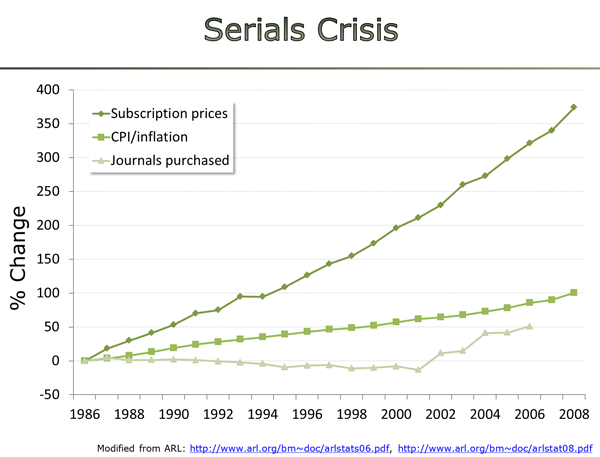
Of course, this is no surprise. After all, maximizing profits is the fiduciary duty of corporate publishers. For this reason, the recent public dreaming about how one could just switch to open access publishing by converting subscription funds to APCs are ill-founded. Proponents may argue that the intent of the switch is to use library funds to cover APC charges for all published articles. This is a situation we have already had before. This is what happens when you allow professional publisher salespeople to negotiate prices with our unarmed and unsupported academic librarians – hyperinflation:

Given this subscription publisher track record (together with the available current evidence of double digit percentage APC increases by NPG, Emerald or Frontiers, or the already now above-inflation increase in APCs more generally), I think it is quite reasonable to remain somewhat skeptical that in the hypothetical future scenario of the librarian negotiating Big Deal APCs with publishers, the publisher-librarian partnership will not again be lopsided in the publishers’ favor.

The current scholarly publishing market is worth round US$10bn annually, so this is what publishers will shoot for in total revenue. In fact, if a lesser service (subscriptions) was able to extract US$10bn, shouldn’t a better service (open access) be able to extract 12 or 15bn from the public purse? Hence, any cost-savings assumed to come from corporate gold OA are naive and completely imaginary at this point.

In fact, if the current reluctance to cancel/not renew the more and more obsolete subscriptions is anything to go by, such Open Access Big Deals will be even more of a boon for publishers than subscriptions. The most cited reason for continued subscription negotiations and contracts is perceived faculty demand. One needs to emphasize that this demand here merely constitutes unwillingness to spend a few extra clicks or some wait time to get the article, in most cases. In contrast, when the contracts are about APCs, they do not concern read-access, but write-access. If a library were to not pay a Big APC Deal any more, it would essentially mean that their faculty would be unable to publish. Hence, if librarians now worry about the consequences of their faculty having to click a few extra times to get an article, they ought to be massively worried what happens when their faculty can’t publish in certain venues any more. Faculty response will be disproportionately more vicious, I’d hazard a guess.

One might argue that without library deals, the journals compete for authors, keeping prices down. This argument forgets that we are not free to choose where we publish: only publications in high-ranking journals will secure your job in science. These journals are the most selective of all journals. In the extreme cases, they only publish 8% of all submitted articles. This is an expensive practice as even the rejected articles generate some costs. It is hence not surprising that also among open access journals, APCs correlate with their standing in the rankings and hence their selectivity (Nature Communications being hence just a case in point). In fact, this relationship is the basis for pricing strategies at SpringerNature (the corporation that publishes the Nature brand): “Some of our journals are among the open access journals with the highest impact factor, providing us with the ability to charge higher APCs for these journals than for journals with average impact factors. […] We also aim at increasing APCs by increasing the value we offer to authors through improving the impact factor and reputation of our existing journals.” It is reasonable to assume that authors in the future scenario will do the same they are doing now: compete not for the most non-selective journals (i.e., the cheapest), but for the most selective ones (i.e., the most expensive). Why should that change, only because now everybody is free to read the articles? The new publishing model would even exacerbate this pernicious tendency, rather than mitigate it. After all, it is already (wrongly) perceived that the selective journals publish the best science (they publish the least reliable science). If APCs become predictors of selectivity because selectivity is expensive, nobody will want to publish in a journal without or with low APCs, as this will carry the stigma of not being able to get published in the expensive/selective journals.

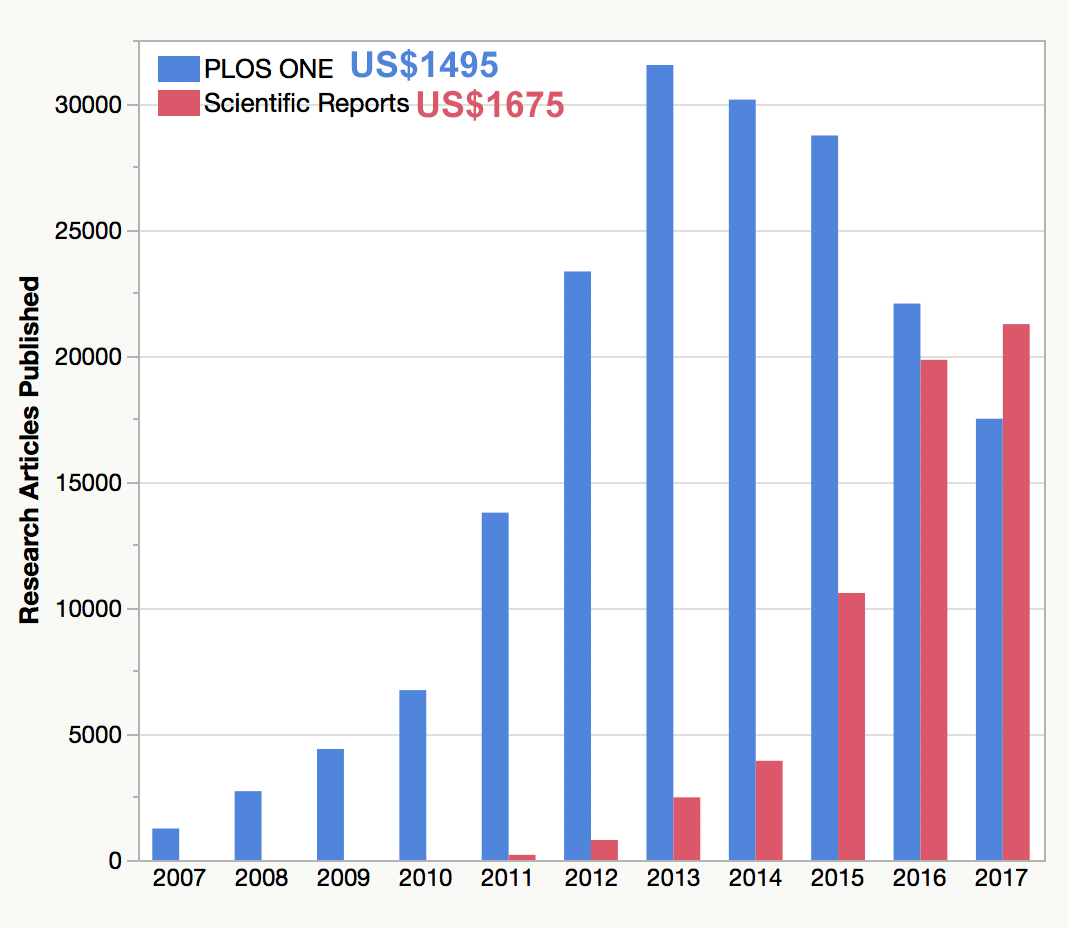
There are even data to suggest that this is already happening. PLoS One and Scientific Reports (another Nature brand journal) are near identical megajournals, which essentially only differ in two things: price and the ‘Nature’ brand. If competition would serve to drive down prices, authors would choose PLoS One and shun Scientific Reports. However, the opposite is the case, falsifying the hypothesis that a gold Open Access market would serve to keep prices in check:

Proponents of the “competition will drive down prices” mantra will have to explain why their proposed method fails to work in this example, but would work if all journals operated in the same way. One could go one step further: just as scholars now are measured by the amount of research funds (grants) they have been able to attract for their research in a competitive funding scheme, it seems only consequential to then also measure them by the amount of funds they were able to spend on their publications in a competitive publications scheme, if the most selective journals are the ones charging the highest APCs: the more money one has spent on publications, the more valuable their research must be. In other words, researchers will actively strive to only publish in the most expensive journals – or face losing their jobs.

Also here, we are already seeing the first evidence of such stratification in terms of who can afford to pay  to publish in prestigious journals. A recent study showed that higher ranked (thus, richer and more prestigious) universities tend to pay more for open access articles in higher ranking journals, while authors from lower ranking institutions tend to publisher either in closed access journals or cheaper open venues. Thus, the new hierarchies are already forming, showing us how this brave new APC world will look like.

This, to me as a non-economist, seems to mirror the dynamics of any other market: the Tata is no competition for the Rolls Royce, not even the potential competition by Lamborghini is bringing down the prices of a Ferrari to that of a Tata, nor is Moët et Chandon bringing down the prices of Dom Perignon. On the contrary, in a world where only Rolls Royce and Dom Perignon count, publications in journals on the Tata or even the Moët et Chandon level will only be ignored. Moreover, if libraries keep paying the APCs, the ones who so desperately want the Rolls Royce don’t even have to pay the bill. Doesn’t this mean that any publisher who does not shoot for at least US$5k in their average APCs (better more) fails to fulfill their fiduciary duty in not one but two ways: not only will they lose out on potential profit, due to their low APCs, they will also lose market share and prestige. Thus, in this new scenario, if anything, the incentives for price hikes across the board are even higher than what they are today. Isn’t this scenario a perfect storm for runaway hyperinflation? Do unregulated markets without a luxury segment even exist?

Of course, if libraries refuse to pay above a certain APC level (i.e., price caps), precariously employed authors won’t have any other choice than to cough up the cash themselves – or face the prospect of flipping burgers. Coincidentally, price caps would entail that those institutions which introduce these caps, have to live with the slogan “we won’t pay for your Nature paper!”, so I wonder how many institutions will actually decide to introduce such caps and what this decision might mean for their attractiveness for new faculty.

One might then fall back on the argument that at least journal-equivalent Fiat will compete with Journal of Peugeot for APCs, but that forgets that a physicist cannot publish their work in a biology journal. Then one might argue that mega-journals publish all research, but given the constant consolidation processes in unregulated markets (which is alive and well also in the publishing market as was recently reported), there quickly won’t be many of these around any more. As a consequence, they are, again, free to increase prices. Indeed, NPG’s Scientific Reports has now overtaken PLoS ONE as the largest mega-journal, despite charging more than PLoS ONE, as shown in the figure above. No matter how I try to turn the arguments around, I only see incentives for price hikes that will render the new system just as unsustainable as the current one, only worse: failure to pay leads to a failure to make your discovery public and no #icanhazpdf or Sci-Hub can mitigate that. Again, as in all scenarios and aspects discussed above, also this kind of scenario can only be worse than what we have now.

In the end, it seems the trust in ‘market forces’ and ‘competition’ to solve these problems for us is about as baseless and misguided as the entire neoliberal ideology from which this pernicious faith springs.

At the very least, if there ever should be universal gold OA, the market needs to be heavily regulated with drastic, enforced, world-wide, universal price caps much below current article processing charges, or the situation will be worse than today: today, you have to cozy up with professional editors to get published in ‘luxury segment’ journals. In a universal OA world, you would also have to be rich. This may be better for the public in the short term, as they then would at least be able to access all the research. In the long term, however, if science suffers, so will eventually the public. In today’s world, one needs some tricks to read paywalled articles, such as Sci-Hub or #icanhazpdf or friends at rich institutions. In this brave new universal gold OA world, you need cold, hard cash to even be able to get read. Surely, unpublished discoveries must be considered worse than hard-to-read, but published discoveries?

Thus, from any perspective, gold OA with corporate publishers will be worse than even the dreaded status quo. [UPDATE I: After I wrote this post, the American Research Libraries posted an article pretty much along the same lines, emphasizing the reduced market power of the individual authors above and beyond many of the same concerns I have raised above. Clearly, a quick analysis by anyone will reveal the unintended consequences of merely ‘flipping’ existing journals to an APC-based OA format. UPDATE II: A few month after this post, a recent study by several research-intensive universities in the US also came to the same conclusions as the ARL and yours truly: “the total cost to publish in a fully article processing charge-funded journal market will exceed current library journal budgets”]

Obviously, the alternative to gold OA cannot be a subscription model. What we need is a modern scholarly infrastructure, around which there can be a thriving marketplace of services for these academic crown jewels, but the booty stays in-house. We already have many such service providers and we know that their costs are at most 10% of what the legacy publishers currently charge. How can we afford such a host of modern functionalities and get rid of the pernicious journal rank at the same time?

Institutions with sufficient subscription budgets and the motivation to reform will first have to coordinate with each other to safeguard the back issues. Surprisingly, there are still some quite substantial technical hurdles, but, for instance, a cleverly designed combination of automated, single-click inter-library loan, LOCKSS and Portico by the participating institutions, should be able to cover the overwhelming part of the back archives. For whatever else remains, there still is Sci-Hub et al.

Once the back-issues are made accessible even after subscriptions run out, a smart scheme of staged phasing out of big subscription deals will ensure access to most of these issues for at least 5 years if not more. In this time, some of the freed funds from the subscriptions can be used to pay for single article access for newly published articles. The majority of the funds would of course go towards implementing the functionalities which will benefit researchers to such an extent, that any small access issues seem small and negligible in comparison.

In conclusion, there is no way around massive subscription cuts, both out of financial considerations and to put an end to pernicious journal rank. If cleverly designed, most faculty won’t even notice the cuts, while they simultaneously will reap all the benefits. Hence, there is no reason why people without infrastructure expertise (i.e., faculty generally), should be involved in this reform process at all. Much like we weren’t asked if we wanted email and skype. At some point, we had to pay for phone calls and snail mail, while the university covered our email and skype use. At some point, we’ll have to pay subscriptions, while the university covers all our modern needs around scholarly narrative (text, audio and video), data and code.

It’s clearly not trivial, but the savings of a few billion dollars every year should grease even this process rather well, one would naively tend to think.

UPDATE III (14/12/2017): Corroborating the arguments above, a recent analysis from the UK, a country who has favored gold Open Access for the last five years, comes to the conclusion that “Far from moving to an open access future we seem to be trapped in a worse situation than we started“. I think it is now fair to say that gold open access is highly likely to  make everything worse (rather than ‘may‘ as in the title of this post). UPDATE to the update (08/05/2018): A Wellcome Trust analysis also found average APCs to rise between 7% and 11%, i.e., double to triple inflation rate, year over year. Clearly, if more and more gold OA journals indeed would lead to more competition, it’s not driving down prices, on the contrary.

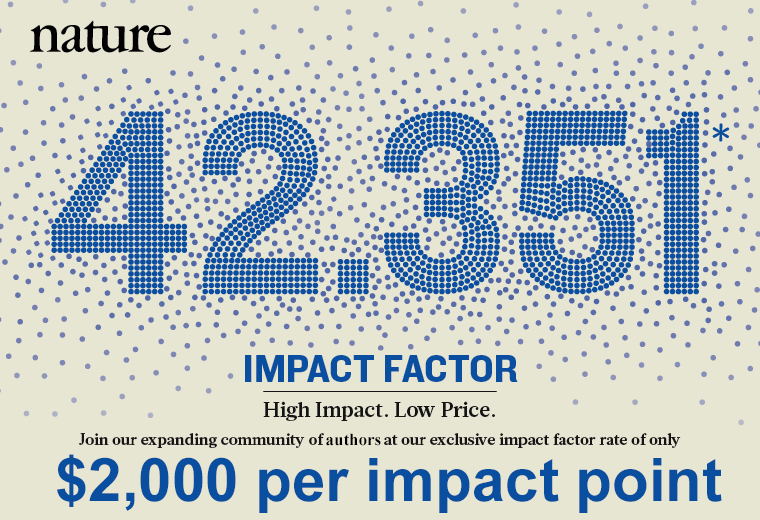
UPDATE IV (19/12/2017): I just went back to Nature‘s old statement in front of the UK parliament, added about 6% in annual price increases (a bit above APC increases and a bit below subscription increases, see above) and arrived at about £22,600-£67,800 that Nature would need to charge for an article in their flagship journal, if they went gold open access today. At current exchange rates, this would amount to about US$30,000-90,000. Rounded out to about US$1000-2000 per impact point:

If one looks at Nature’s actual subscription increases from 2004 to today, they are much lower and amount to an increase of about 25%. This would bring us to pretty much exactly US$50,000 per article, at the current exchange rate. So depending on how one calculates, 30-90k per article for a high impact journal seems what has to be expected.

UPDATE V (14/09/2018): At the persistent request from a reader, I’m extending the discussion on the content of this post to a more suitable forum.

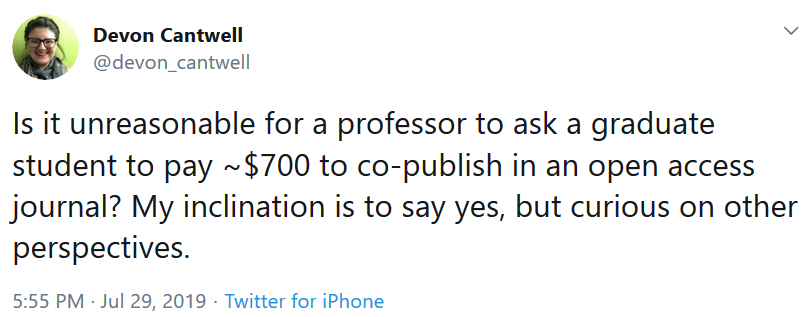
UPDATE VI (30/07/2019): Not surprisingly, students are being asked to co-pay the APCs:

Clearly, those who find tuition fees reasonable will argue that this is the best investment in their career that the PhD student can make. Those who argue that price sensitivity of authors will help bring down publisher prices will also find this very reasonable.

Posted on April 7, 2016 at 13:23 65 Comments
Mar23

Have you seen this response to terrorism anywhere?

In: Uncategorized • Tags: politics, terrorism

I usually don’t write about politics, but there has been one or the other exception to this rule in the last 12 years of this blog. This time, I’ve been missing one particular response to the various terrorist attacks in recent times, perhaps one of the few readers of this obscure blog has found it somewhere and can point me in this direction? I’m looking for something like this:

“Sadly, it is very difficult to completely prevent casualties such as those in the recent terror attacks in Madrid, London, Paris, Brussels or elsewhere, without violating basic human rights and abandoning hard-won liberties. Our ancestors have given their lives for these rights and liberties and we, as a society, are equally willing to pay that price. However, the victims of these horrific attacks have never been asked to give their lives. They were forced to become martyrs for our human rights and our civil liberties. It is infuriating and frustrating that there seems to be only little we can do to prevent such deaths. However, there are ~1.2M preventable deaths in Europe alone every year. We propose to do something about these lives instead. These fatalities are due to causes such as lung cancer, accidental injuries, alcohol related diseases, suicides and self-inflicted injuries. With even in the 1970s and 1980s terrorist-related fatalities never exceeding 500 per year, we will honor the lives of the victims of terrorism by initiating a program that will save at least 100 lives for every one that is being taken in a terrorist attack.

To reach this ambitious goal, we will start with increasing our efforts to prevent alcohol and tobacco-related deaths through effective public-health intervention programs as well as basic and applied biomedical research into the prevention, causes and treatment of these diseases and disorders. With about 30.000 annual fatalities in traffic-related accidents, we will also introduce European-wide speed limits, strong enforcement via speed-traps and an increased police force which collaborates across Europe. Drivers convicted of violating speed limits or DUI will have their driver’s licenses withdrawn for extended periods of time. We will increase our investments in the development of driverless vehicles. Should these activities fail to reach these goals, we will start targeting more areas. The individual projects will be named after the victims of terrorism, as a reminder of their forced contribution to the improvement of our open society. This program will be implemented on top of the intensified, heroic efforts of our law enforcement and intelligence agencies working hard to prevent such attacks within the bounds of our open society. We will strive to reach these goals in addition to our enduring political and diplomatic initiatives to mitigate the religious, socio-economic and political circumstances which can be used to recruit and motivate terrorists.

This death prevention program will not only protect our basic human rights and civil liberties, it will also benefit the economy in general and increase employment in particular. Through the additional investment in prevention, diagnosis and treatment, our public health systems will benefit long after any terrorist groups have ceased to exist. Our extra investment in basic and applied research will yield discoveries that will benefit all of humanity long after the last terrorist has sacrificed his life in vain. With our new program, every single terrorist attack will save the lives of countless more citizens than it has cost, turning terrorism into a net life-saving activity.”

If you have found an advocate for such a program, or one like it, please let me know where to find them, I’d like to support them.

Posted on March 23, 2016 at 10:20 15 Comments
Mar14

Seeking your endorsement

In: science politics • Tags: european commission, open science

I am contemplating to apply to join the European Commission Open Science Policy Platform. The OSPP will provide expert advice to the European Commission on implementing the broader Open Science Agenda. As you will see, some of us have a concern that the focus of the call is on organizations, not communities. This is a departure from much of the focus that the Commission itself has adopted on the potential benefits and opportunities of Open Science. A group of us are therefore applying as representatives of the community of interested and experienced people in the Open Science space.

Amongst others I am therefore asking for your endorsement, in the form of a comment on this post or email directly to me if you prefer, as someone who can represent this broader community of people, not necessarily tied to one type of organization or stakeholder. Depending on the number of endorsements, I will consider submitting my application. Deadline is march 22, 2016.

Application:

I have been urged to apply for a position on the advisory group ‘Open Science Policy Platform‘ as an individual representing the common interests shared by people and organizations from across the spectrum of stakeholders including doctors, patients and their organizations, researchers, technologists, scholarly IT service providers, publishers, policy makers, funders and all those interested in the change undergoing research. In addition to those directly involved in Open Science, I also represent the common interests shared by experimental scientists at public institutions, in particular those working in biomedical research, whether or not they are already engaging in Open Science themselves.

Many of us have a concern that the developing policy frameworks and institutionalization of Open Science is leaving behind precisely the community focus that is at the heart of Open Science. As the Commission has noted, one of the key underlying changes leading to more open practice in research is that many more people are becoming engaged in research and scholarship in some form. At the same time the interactions between this growing diversity of actors increasingly form an interconnected network. It is not only that this network reaches beyond organizational and sector boundaries but that it is precisely that blurring of boundaries is what underpins the benefits of Open Science.

I recognize that for practical policy-making it is essential to engage with key stakeholders with the power to make change. In addition I would encourage the Commission to look beyond the traditional sites of decision-making power within existing institutions to the communities and networks which are where the real cultural changes are occurring. In the end, institutional changes will only ever be necessary, and not sufficient, to support the true cultural change which will yield the benefits of Open Science.

I am confident I can represent the interests of this community, particularly by assisting in developments concerning the implementation of a cloud-based scholarly infrastructure supporting not only our text-based research outputs, but especially the integration of research data and scientific source code with the narrative, be it text, audio or video-based. I will also contribute evidence to policy decisions regarding research integrity.

I base my confidence on my track record covering the last 12 years. I have been involved in Open Science advocacy since about 2004. Since then, I have been invited speaker and keynote lecturer at numerous Open Science events every year. My advice is being sought by Open Access organizations such as the Public Library of Science, Force11, Frontiers, ScienceOpen, PeerJ or F1000. In fact, most of the recent F1000 innovations appear very similar to what I (and no doubt others) have proposed. I run an Open Science laboratory where all our source code and research data are being made openly accessible either immediately, as they are being created/collected, or upon publication/request. We have pioneered exploiting the advantages the infrastructure of our laboratory provides. For instance, we have collaborated with F1000Research to publish an article where the reader can not only choose the display format of the research data, or which aspect of the data should be displayed, but where they can also contribute their own data for comparison and extension of the published research.

My perspective is shaped not only by my interactions with fellow scholars, librarians or publishers. I also collect the available empirical data to objectively assess the state of the current scholarly infrastructure. One of the insights we have gained from this work is that the most prestigious scholarly journals publish the least reliable science. The practice of selecting scholars publishing in these prestigious journals arguably contributes to the unfolding replication crisis. Thus, a drop in research integrity has been observed in recent years, which can be traced back to inadequate, antiquated infrastructure, providing counter-productive incentives and reward structures. I will bring to the table the evidence-based perspective that our public institutions need a modern digital infrastructure, if our aim is to prevent further deterioration of research integrity and hence credibility. This position holds that the current, largely journal-based and publisher-provided infrastructure is not only counter-productive, but also unnecessarily wasteful. The evidence suggests that the global scholarly community stands to save ~US$9.8 billion annually if current subscription moneys were instead invested in a modern, institutional infrastructure. Such a transition would not only maintain current functionalities, it would also provide universal access to all scholarly knowledge. The saved funds would provide ample opportunities for acquiring new functionalities, provided, for instance, by emerging scholarly IT service providers, representatives of which will likely be among the experts on the Open Science Policy Platform. The saved funds would also allow implementation of a sustainable infrastructure ensuring long-term accessibility and re-use of research data as well as scientific source code. The common, federated standards and specifications of this infrastructure will overcome current fragmentation and enhance interoperability of all forms of scholarly output. Europe is spearheading the development of such an infrastructure. Given the proposed 6.15b€ for the European Cloud Initiative, the evidence suggests that the transition will likely be cost-neutral overall and potentially even cost-saving.


Posted on March 14, 2016 at 22:32 98 Comments
Mar08

How do academic publishers see their role?

In: science politics • Tags: publishers

Over the years, publishers have left some astonishingly frank remarks over how they see their role in serving the scholarly community with their communication and dissemination needs. This morning, I decided to cherry-pick some of them, take them out of context to create a completely unrealistic caricature of publishers that couldn’t be further from the truth. However, I’ll leave the links to the comments, so you can judge for yourself just how out of context they actually have been taken.

Essentially all of these comments were voiced on the blog of the Society for Scholarly Publishing, an organization representing academic publishers. For one of the commenters, Joseph Esposito, it is likely safe to assume that his continued presence as main contributor to the blog means that these viewpoints reflect the general viewpoints of the members of this association closely enough to not warrant dismissal from the site. The other quoted commenter, Sanford Thatcher, is not a contributor to the blog at all, so there is no direct way of estimating how representative his views are. Both commenters are or have been either publishers themselves or consult publishers in various roles.

  1. Publishers don’t add any value to the scholarly article:

Now you can find an article simply by typing the title or some keywords into Google or some other search mechanism. The Green version of the article appears; there is no need to seek the publisher’s authorized version.

Source.

2. Publishers’ business of selling scholarly articles to a privileged few is not negotiable

Screenshot via Mike Taylor

Screenshot via Mike Taylor

3. The purpose of academic publishers is to make money, not to serve the public interest:

It is not the purpose of private enterprises to serve the public interest; it is to serve the interests of their stockholders. On the other hand, it is the purpose of the federal government to serve the public interest.

Source.

4. Governments ought to serve the public interest by funding all scholarly communication:

you should be urging the government to better disseminate the results of the research it sponsors.

Source.

Let’s take these comments and completely mangle the impression publishers publicly express of themselves: “We don’t really have anything of value to contribute, but it is our non-negotiable fiduciary duty to make as much money off the public purse as possible. If you want to change that, you should take all the tax-money we’ve suckered you into handing over to us and build a sustainable scholarly communication infrastructure yourselves.” Couldn’t have said it better myself, actually.

Posted on March 8, 2016 at 11:47 36 Comments
Mar03

Academic publishers: stop access negotiations

In: science politics • Tags: esposito, open access, publishers

Three years ago, representatives of libraries, publishers and scholars all agreed that academic publishers don’t really add any value to scholarly articles. Last week, I interpreted Sci-Hub potentially being a consequence of scholars having become tired after 20 years of trying to wrestle their literature from the publishers’ stranglehold by small baby-steps and through negotiations and campaigning alone. Maybe the developments could be an indication that the frustration may be growing among scholars, readying them to break ranks with publishers altogether?

After 20 years of negotiations about how to realize universal open access to all scholarly literature with publishers, maybe it’s time to stop negotiations and develop an open access infrastructure without publishers? After all, it would save human lives as well as billions of dollars every year.

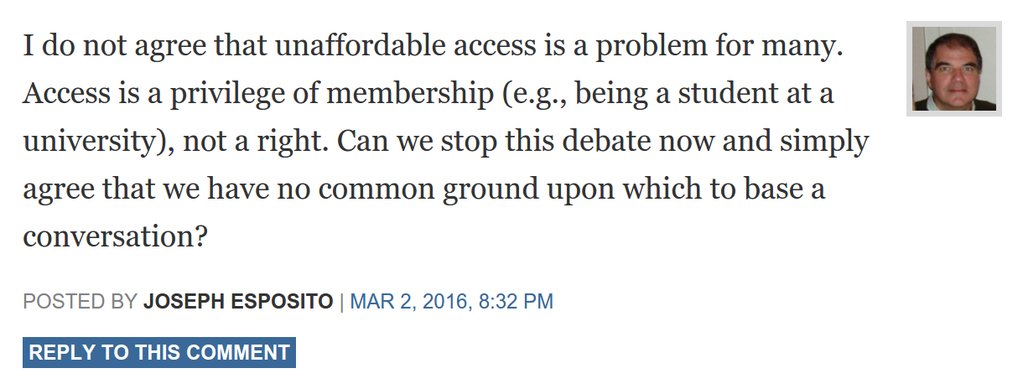
I had not anticipated support for the notion of stopping negotiations with publishers from the same person who also confirmed that publishers add little value to scholarly articles three years ago, Joseph Esposito. In his own words, Mr. Esposito is a “publishing consultant”, working for publishers involved in research publishing. He advises these companies on strategies concerning, among other issues, open access. Until this writing, he has penned 253 articles for the blog of the Society for Scholarly Publishing, an organization representing academic publishers. It is probably safe to assume that his continued presence at this blog after such a number of posts can be taken as an indicator that his opinions expressed there are generally not in obvious disagreement with those of the academic publishers as members of the society. His continued success as consultant to some of said society members can also be taken as an indication that his advice is being followed by his clients. In brief, the word of Mr. Esposito has carried and continues to carry some significant weight with publishers.

For the second time in three years, Mr. Esposito and I agree on something: we should stop negotiating access with legacy publishers:

Screenshot via Mike Taylor

Screenshot via Mike Taylor

Quite clearly (this is the full account of the entire comment, so it cannot be taken out of context), for Mr. Esposito, access to the scholarly literature is a privilege worth paying for. Moreover, he sees no need to negotiate this position any further. Inasmuch as this opinion instructs his advice to publishers, scholars should not be surprised, for instance, that publishers actively block contentmining and will not negotiate about this blockade of science. This opinion also reinforces my assessment that talking with legacy publishers, at this point, has become a complete waste of time. This is how far they are willing to go and no further concessions can be expected.

Posted on March 3, 2016 at 17:28 28 Comments
  • Page 10 of 22
  • « First
  • «
  • 8
  • 9
  • 10
  • 11
  • 12
  • »
  • Last »

Linking back to brembs.net


My lab:
lab.png
  • Popular
  • Comments
  • Latest
  • Today Week Month All
  • Elsevier now officially a "predatory" publisher (24,321 views)
  • Sci-Hub as necessary, effective civil disobedience (23,092 views)
  • Even without retractions, 'top' journals publish the least reliable science (15,557 views)
  • Booming university administrations (12,946 views)
  • What should a modern scientific infrastructure look like? (11,505 views)
  • Posters on molecular mediators of learning, dopamine and habit formation at #FENS2026
  • After decades of debating the “scientific publishing crisis”, the time has come to decide.
  • Retraction data are still useless – almost
  • Procurement Before Prestige
  • Motor learning mechanisms at #SfN25
  • Today Week Month All
  • Booming university administrations
  • Even without retractions, 'top' journals publish the least reliable science
  • What should a modern scientific infrastructure look like?
  • Science Magazine rejects data, publishes anecdote
  • Recursive fury: Resigning from Frontiers
Ajax spinner

Networking

Brembs on MastodoORCID GScholar GitHub researchgate

View Bjoern Brembs

Aplysia biting
Aplysia biting

Video von YouTube laden. Dabei können personenbezogene Daten an Drittanbieter übermittelt werden. Hinweise zum Datenschutz

login

  • Register
  • Recover password

Creative Commons License bjoern.brembs.blog by Björn Brembs is licensed under a Creative Commons Attribution 3.0 Unported License. | theme modified from Easel | Subscribe: RSS | Back to Top ↑

[ Placeholder content for popup link ] WordPress Download Manager - Best Download Management Plugin

bjoern.brembs.blog
Proudly powered by WordPress Theme: brembs (modified from Easel).